
Redstone is one of the most powerful and flexible resources in Minecraft. It acts as the game’s logic and power system, allowing players to build automated farms, complex machines, traps, transportation networks, and even functional computers.
While Redstone can feel overwhelming at first, understanding how it spawns, how it behaves, and how to mine it efficiently makes it far more approachable.
This guide covers everything you need to know about redstone in modern Minecraft (2026)—from where it generates and how to mine it properly to advanced mechanics and practical tips used by experienced players.
What Is Redstone in Minecraft?
In most cases, “redstone” refers to redstone dust, which is dropped when mining redstone ore. When placed on the ground, redstone dust functions as a signal wire that transmits power between blocks. These signals are used to activate redstone components such as pistons, doors, dispensers, droppers, lamps, and more.
Redstone exists in two ore forms:
- Redstone Ore (generates above Y=0)
- Deepslate Redstone Ore (generates below Y=0)
Both variants drop the same items and behave identically, though deepslate redstone takes longer to mine.
Where Redstone Spawns (Current Generation Mechanics)
Redstone generates only in the Overworld and appears in veins of 1 to 8 blocks.
Best Y-Level for Redstone
- Optimal mining level: Y-59
- Redstone generates between Y-63 and Y-15
- The deeper you go, the more frequently it appears
At Y-59, you are just above bedrock, where redstone density is highest while still allowing efficient mining without excessive bedrock interference.
Redstone ore can generate replacing:
- Stone
- Deepslate
- Tuff
- Granite
- Diorite
- Andesite
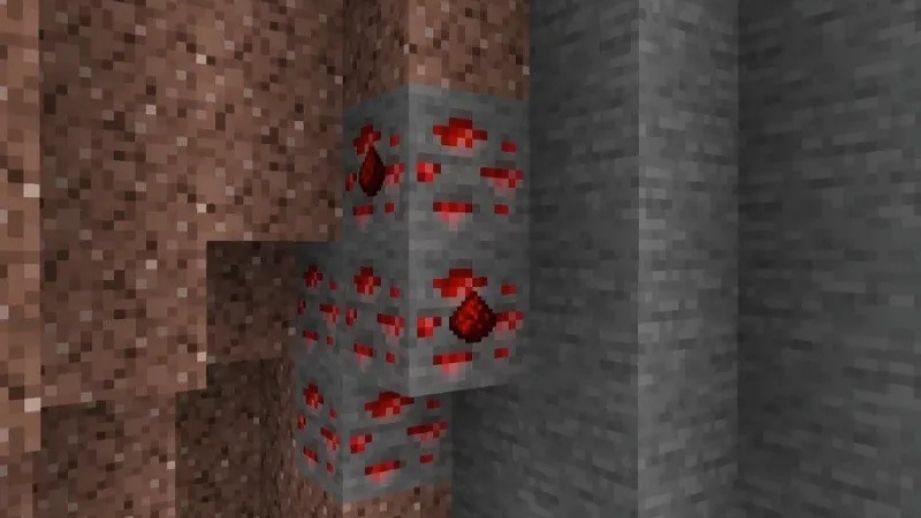
Because of this, redstone commonly appears mixed into many different block types, especially in deep caves and large underground caverns.
Best Ways to Find Redstone Quickly
Branch Mining (Most Consistent)
Branch mining at Y-59 remains one of the most reliable methods. Dig a main tunnel and create side branches every two blocks. This exposes the maximum number of blocks while minimizing effort, tool durability loss, and risk.
Cave Mining (Fast but Dangerous)
Large caves below Y-30 often expose redstone veins directly on walls, floors, and ceilings. This can be faster than branch mining but comes with higher risk due to lava pools, mob spawns, and vertical drops.
Strip Mining (Inefficient)
Strip mining clears large areas but is generally less efficient than branch mining. It consumes more time and durability while exposing fewer blocks overall.
How to Mine Redstone Correctly
Required Pickaxe
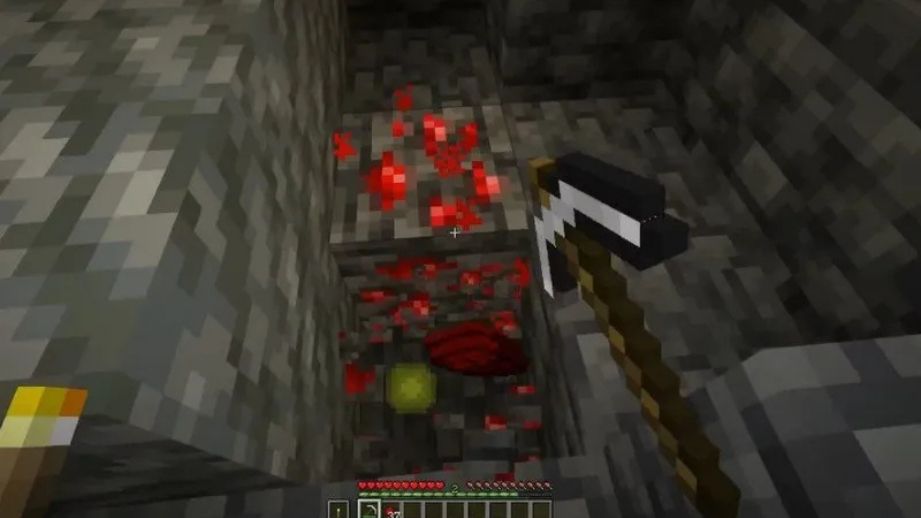
To mine redstone, you must use at least:
- Iron pickaxe
- Gold, diamond, or netherite pickaxes also work
❌ Wooden and stone pickaxes will break the ore without dropping redstone.
Drops and Enchantments
- Each redstone ore drops 4–5 redstone dust
- Fortune greatly increases yield:
- Fortune I: up to ~6
- Fortune II: up to ~7
- Fortune III: up to 8 dust per block
Fortune vs Silk Touch
- Fortune is almost always better
- Silk Touch preserves the ore block, but smelting it yields only 1 redstone dust, making it inefficient unless the block is needed for storage or decoration.
Redstone Behavior You Should Know
- Redstone ore glows when stepped on or mined, making it easier to spot in dark areas
- Redstone dust transmits power up to 15 blocks
- Signal strength weakens over distance unless refreshed by repeaters
- Redstone dust does not climb blocks on its own
- Vertical signal routing requires deliberate setups using slabs, stairs, observers, or other components
- Redstone dust cannot be placed underwater, but most redstone components still function normally in water
Understanding these mechanics is essential for building compact, reliable contraptions.
Alternative Ways to Obtain Redstone
If mining isn’t your preferred method, redstone can also be obtained through other gameplay systems.
Mob Drops
- Witches can drop redstone dust when killed
Villager Trading
- Cleric villagers sell redstone for 1 emerald
- This becomes extremely efficient in cured villager trading halls
Structures
Redstone dust or components can be found in:
- Jungle Temples (tripwire traps)
- Ancient Cities
- Woodland Mansions
- Trial Chambers
These sources are useful early-game but are not substitutes for large-scale mining.
What Redstone Is Used For?
Redstone enables automation, logic, and timing systems across the game.
Common Redstone Applications
- Automatic crop and mob farms
- Item sorters and storage systems
- Piston doors and hidden bases
- Minecart and rail systems
- Traps and defensive builds
- Redstone clocks and timers
- Flying machines
- Auto-smelters and super smelters
Redstone is also used in potion brewing and crafting essential utility items.
Essential Redstone Crafting Recipes
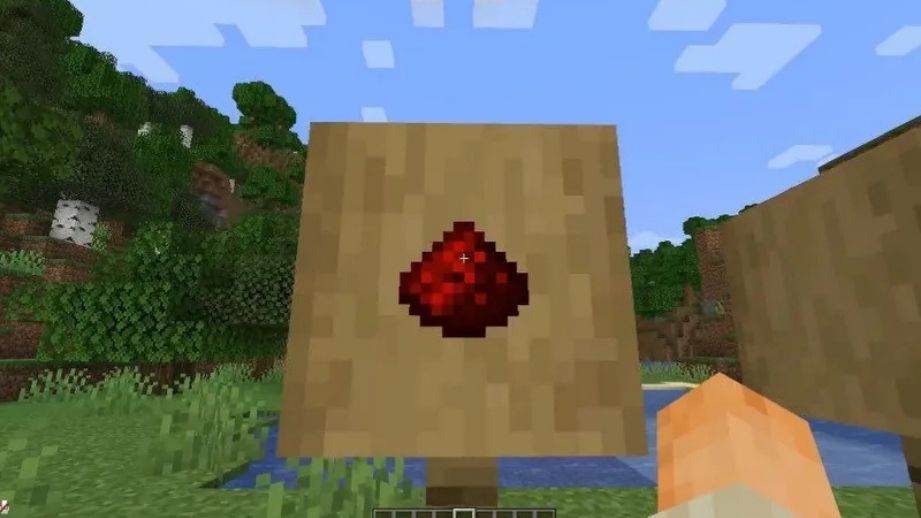
Some of the most important redstone-related recipes include:
- Compass – 4 Iron Ingots + 1 Redstone Dust
- Clock – 4 Gold Ingots + 1 Redstone Dust
- Redstone Torch – 1 Stick + 1 Redstone Dust
- Repeater – 2 Redstone Torches + 1 Redstone Dust + 3 Stone
- Comparator – 3 Stone + 1 Nether Quartz + 3 Redstone Torches
- Observer – 6 Cobblestone + 2 Redstone Dust + 1 Nether Quartz
- Piston – 3 Planks + 4 Cobblestone + 1 Iron Ingot + 1 Redstone Dust
- Dispenser – 7 Cobblestone + 1 Bow + 1 Redstone Dust
- Dropper – 7 Cobblestone + 1 Redstone Dust
- Powered Rail – 6 Gold Ingots + 1 Stick + 1 Redstone Dust
- Redstone Lamp – 1 Glow-stone + 4 Redstone Dust
- Note Block – 8 Planks + 1 Redstone Dust
- Redstone Block – 9 Redstone Dust
Advanced Redstone Tips:
- Use Night Vision potions when mining to spot glowing redstone easily
- Carry Fire Resistance when mining near bedrock to counter lava pools
- Use repeaters to maintain signal strength over long distances
- Comparators can read container fullness, enabling smart storage systems
- Redstone blocks provide constant power and simplify compact designs
- Observers detect block updates, not movement—critical for precise timing
- In Java Edition, be mindful of spawn chunks, which stay loaded and can cause redstone to run continuously
Common Redstone Mistakes to Avoid:
- Forgetting the 15-block signal limit
- Mixing Java-only mechanics into Bedrock builds
- Overusing dust instead of repeaters
- Ignoring chunk loading behavior in large machines
- Building always-on contraptions unintentionally
Final Thoughts
Redstone is one of Minecraft’s deepest and most rewarding systems. Learning where it generates, how to mine it efficiently, and how its mechanics work will dramatically improve both survival gameplay and technical builds.
Whether you’re setting up your first automatic farm or designing large-scale contraptions, redstone is the foundation that makes advanced Minecraft possible.